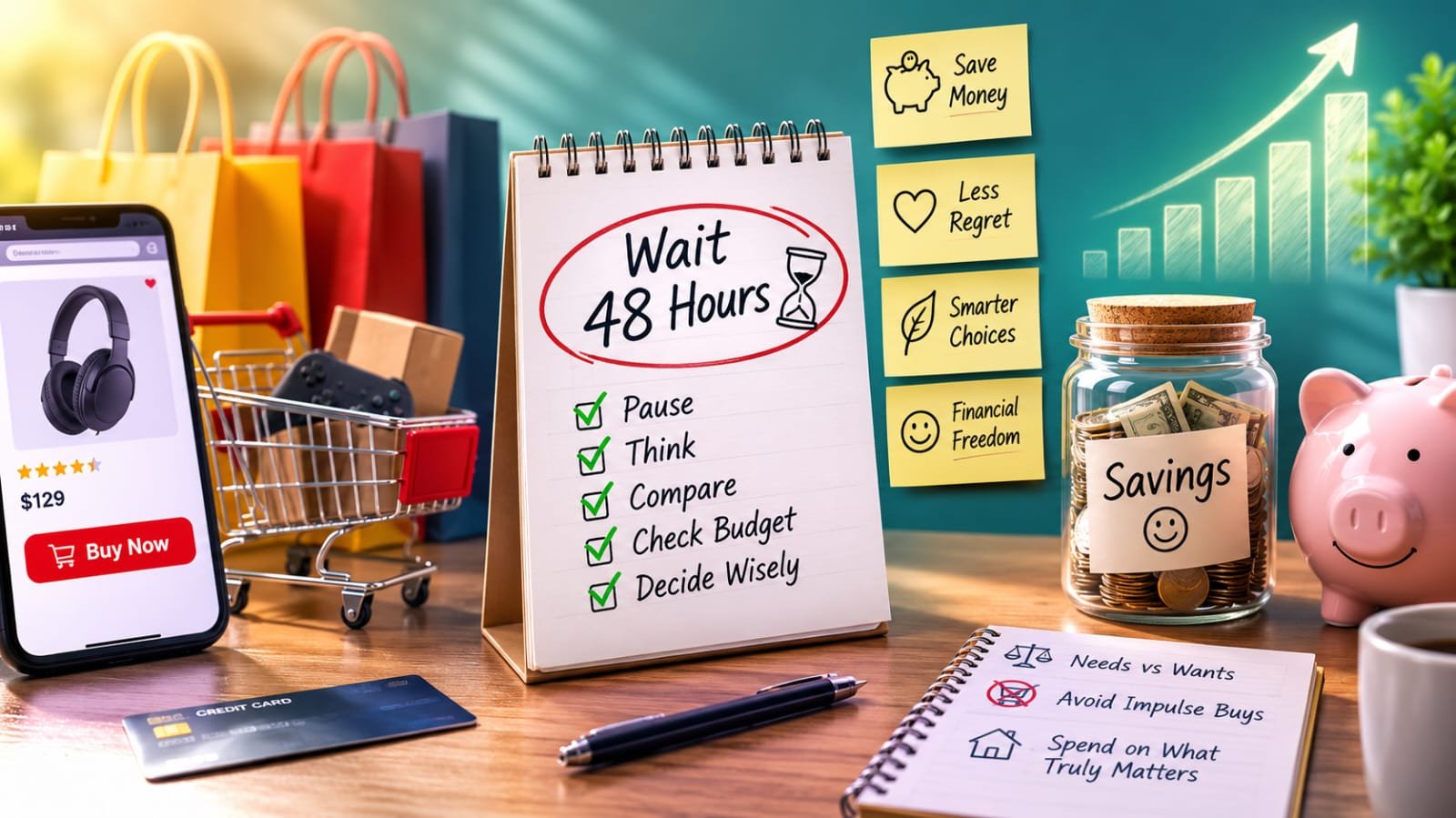
We’ve all been there. You’re scrolling through your phone or walking down a store aisle when something instantly grabs your attention—a sleek gadget, a stylish jacket, or a piece of home décor that suddenly feels essential. As a result, impulse buying can seem almost impossible to resist.
In fact, your brain gets a quick dopamine rush, making the urge to buy feel more like an emergency than a choice. Consequently, you tap “Buy Now,” and the instant gratification feels amazing but only for a short time. However, a few days later, the excitement fades while the purchase continues to drain your budget. Instead of acting on emotion, the 48-Hour Rule encourages you to wait two full days before making any non-essential purchase. During that time, your emotions settle, your logical thinking takes over, and you can decide whether you truly need the item.
Meanwhile, modern retailers carefully design shopping experiences to encourage impulse buying. Fortunately, you don’t need a restrictive or joyless budget to fight back. Rather, you simply need a pause. Ultimately, the 48-Hour Rule gives you that pause, helping you make smarter spending decisions, avoid unnecessary purchases, and keep more of your hard-earned money.
What is the 48-Hour Rule?
The core concept is incredibly straightforward: Whenever you experience the urge to buy a non-essential item, you must force a mandatory 48-hour delay before completing the purchase.
During these two days, the item stays in your online shopping cart, on a wishlist, or on a physical note in your phone. It is not a permanent “no”—it is simply a pause button.
The Neurochemistry of the Impulse Buy
To understand why this rule is so fiercely effective, we have to look at what happens inside your brain when you shop.
When you spot something you want, your brain releases dopamine, the neurotransmitter associated with anticipation and reward. Crucially, dopamine spikes before you buy the item, during the hunting and wanting phase. Retailers maximize this by creating a sense of artificial scarcity:
- “Only 2 left in stock!”
- ”Flash sale ends in 3 hours!”
- ”15 other people have this in their cart right now.”
This triggers an emotional cocktail of excitement and FOMO (Fear of Missing Out). Your prefrontal cortex—the part of your brain responsible for long-term planning and logic—is temporarily offline.
The 48-Hour Rule acts as a circuit breaker. By forcing a temporal gap, you allow the dopamine spike to naturally subside. Once the chemical fog clears, your logical brain wakes back up, allowing you to view the purchase objectively rather than emotionally.
The 48-Hour Checklist: Questions to Ask Yourself
When the 48-hour clock runs out, return to the item and ask yourself these four qualifying questions. If it passes, buy it guilt-free. If it fails, delete it.
1. Where is the money coming from?
If buying this item means pulling from your savings, adding to credit card debt, or skimping on your monthly investment goals, the true cost of the item is much higher than the price tag.
2. How many hours of work does this represent?
Calculate your actual hourly take-home pay (after taxes). If you make $25 an hour after taxes, a $150 impulse purchase doesn’t cost $150—it costs 6 hours of your life spent working. Is that item worth nearly a full day at your desk?
3. What problem does this actually solve?
Does this item fulfill a genuine, recurring need in your daily life, or are you just buying the idea of who you would be if you owned it?
4. Do I still care?
You will be amazed at how often you return to your shopping cart after 48 hours only to realize you’ve completely forgotten why you wanted the item in the first place. The thrill was in the hunt, not the object.
Financial Ripple Effects: The Math Behind the Pause
Let’s look at how saving relatively small amounts of money by avoiding impulse buys compounds over time. Suppose the 48-Hour Rule helps you cut out just $40 a week in unnecessary spending (a couple of random online orders, clothes you won’t wear, or duplicate gadgets).
That rounds out to roughly $160 a month. If you redirect that leaked cash into a basic index fund yielding an average 8% annual return, look at how that minor daily boundary transforms:
| Timeframe | Total Cash Saved | Future Value (with 8% Compounding) |
| 1 Year | $1,920 | $1,920 |
| 5 Years | $9,600 | $11,750 |
| 10 Years | $19,200 | $29,250 |
| 20 Years | $38,400 | $92,300 |
By pausing for 48 hours on things you didn’t truly need, you aren’t sacrificing happiness—you are actively purchasing nearly $100,000 of future financial freedom.
How to Set Up Your System for Success
Willpower alone is a unreliable strategy. To make the 48-Hour Rule stick, build friction into your digital environment so the rule enforces itself:
- Remove Saved Card Details: Delete your credit card information from Amazon, autofill browsers, and favorite clothing sites. Forcing yourself to physically find your wallet and type in 16 digits introduces a friction point that gives you time to think.
- The “Later” Folder: Create a dedicated bookmark folder in your browser or a note on your phone titled “The 48-Hour Hold.” Move wishlist items there immediately.
- Unsubscribe from “Flash Sale” Emails: If a brand relies on daily countdown timers to get you to buy, clear them out of your inbox. Protection is easier than resistance.
The Golden Exception: The 48-Hour Rule shouldn’t apply to true emergencies (like a broken pipe or a sudden medical need) or pre-planned, budgeted necessities. It is strictly a shield against the unplanned “want.”
The Bottom Line
The goal of personal finance isn’t to stop spending money entirely; it’s to ensure that your money is being intentionally directed toward things that bring genuine, lasting value to your life.
Try implementing the 48-Hour Rule starting today. You aren’t telling yourself “no”. You are just saying “not right now.” This simple pause can help you avoid unnecessary purchases and keep more of your money available for what truly matters. Your bank account will thank you.