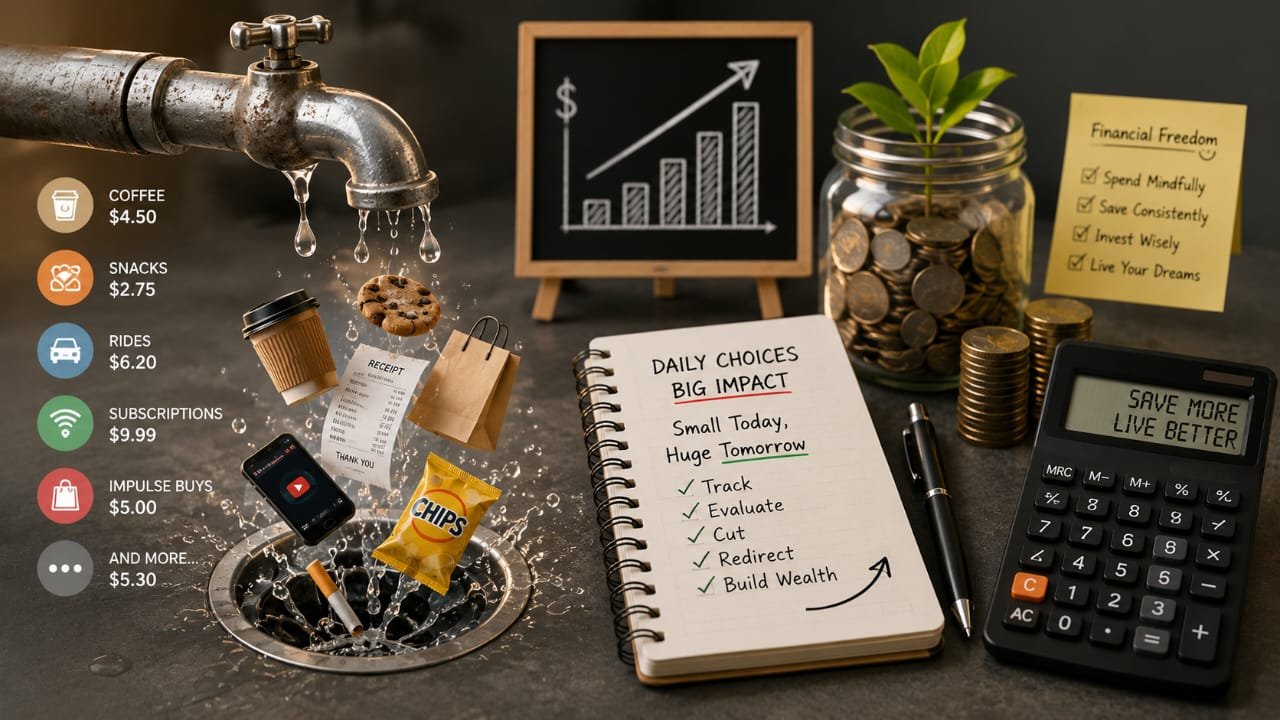
When people decide to improve their finances, they usually focus on making big, dramatic changes. They may consider moving to a cheaper apartment, selling their car, or canceling an upcoming vacation. However, wealth rarely disappears in one major event. Instead, it often slips away through micro drains, small recurring expenses that seem harmless on their own. Although each purchase may cost less than a lunch, collectively these micro drains can quietly drain hundreds or even thousands of dollars over a year.
As a result, they create a steady leak in your budget that often goes unnoticed. If you earn a decent income but still wonder where your money goes before the end of the month, chances are micro drains are the real culprit. Fortunately, once you learn to identify these micro drains, calculate their true cost, and eliminate the unnecessary ones, you can plug the leaks and save more with surprisingly little effort.
The Anatomy of a Micro-Drain
A micro-drain is any transaction that is small enough to escape your daily financial guilt but frequent enough to compound into a major expense. They generally fall into three distinct categories:
1. The Ghost Subscriptions
These are the $1.99, $4.99, or $9.99 monthly charges for services you rarely or never use.
- That premium storage plan for an app you deleted six months ago.
- The streaming service you signed up for just to watch one specific documentary.
- The “free trial” that quietly converted into a paid membership because you forgot to set a calendar reminder.
2. Convenience Premiums
These are the small markups we willingly pay to shave a few minutes off a task, often without realizing how much that convenience costs over time.
- Paying a $4 delivery fee plus a $3 service charge to have a $12 meal brought to your door.
- Using out-of-network ATMs and swallowing the $3.50 fee.
- Buying pre-cut fruits or individual snack packs at twice the price per ounce of the standard version.
3. Mindless Micro-Habits
These are the routine, almost involuntary purchases that anchor our daily schedules.
- The mid-afternoon energy drink or premium coffee run out of boredom.
- In-app purchases or mobile game micro-transactions (“It’s only $0.99 for extra lives!”).
- The impulse candy bar, soda, or pack of gum at the grocery checkout line.
The Psychology: Why We Ignore the Drips
Our brains are fundamentally bad at processing compounding value over long horizons. Retailers and tech companies know this, which is why the modern economy has shifted heavily toward the subscription and micro-transaction model.
When you see a charge for $7 a month, your brain categorizes it as “negligible.” It doesn’t trigger the pain centers in the brain the way a $100 purchase does. Because it doesn’t hurt, you don’t fight it.
Furthermore, we often justify convenience premiums as “self-care” or “time-savers.” While buying time is a valid financial strategy, paying a 40% markup on a meal just because you didn’t want to walk two blocks isn’t buying time—it’s yielding to friction.
The Compounding Math: How Tiny Leaks Sink Big Ships
To fully understand a micro-drain, you must stop looking at its daily or monthly cost and start looking at its annualized trajectory.
Let’s look at four incredibly common micro-drains. See how quickly these “harmless” amounts transform when looked at across a single year, and what that money would look like if it were invested at an 8% average return over a decade instead:
| The Micro-Drain | Cost & Frequency | Annual Impact | 10-Year Invested Opportunity Cost |
| The Unused App/Streaming Trial | $9.99 / month | $120 | $2,100 |
| The In-App Mobile Game Upgrades | $3.00 / week | $156 | $2,730 |
| The Delivery App Service/Tip Fees | $12.00 / week | $624 | $10,910 |
| The Premium Coffee/Energy Drink | $5.50 / workday | $1,430 | $25,000 |
| Total | $2,330 | $40,740 |
By eliminating just these four routine, unoptimized habits, you don’t just save $2,330 this year—you prevent a $40,000 hole in your long-term net worth.
How to Plug the Leaks: A 3-Step Audit
Plugging your micro-drains isn’t about living a life of extreme deprivation. It’s about ensuring that your money only leaves your pocket for things that provide genuine value. Use this three-step framework this weekend to clean house:
Step 1: The “Line-by-Line” Scrape
Log into your bank and credit card portals and export your statements from the last 90 days into a spreadsheet (or print them out). Take a highlighter and mark every single transaction under $15. Look past the big utility bills and focus entirely on the noise. If you don’t instantly recognize the merchant name, look it up.
Step 2: Implement a “Subscription Strike”
For any app or streaming service you haven’t used in the last 30 days, cancel it immediately. Do not fall into the trap of thinking, “But I might want to watch something on there next month.” In the era of digital streaming, you can re-subscribe in 45 seconds if you actually need it. Force the service to win your business back every single month.
Step 3: Attack the Friction Points
For convenience drains, change the environment rather than trying to rely on willpower:
- Move delivery apps off your home screen or delete them entirely so ordering requires opening a laptop and typing in credentials.
- Keep a high-quality travel mug and your favorite brew at your desk so the afternoon coffee run requires a conscious choice to leave, rather than an involuntary craving.
- Set up an account with an online bank that reimburses all ATM fees worldwide, completely erasing the out-of-network penalty.
The Bottom Line
A leaky bucket will eventually empty out, no matter how much water you pour into the top. Increasing your income is fantastic, but if you don’t fix your micro-drains, your expenses will naturally expand to swallow your new salary—a phenomenon known as lifestyle creep.
By taking an hour to hunt down and eliminate these tiny financial drains, you give yourself an immediate, tax-free raise. Stop letting your hard-earned money drip away on things you don’t even care about.