Let’s be honest: nobody wants to spend their weekends staring at spreadsheets, tracking every single dollar spent on coffee, or stressing over manual bill payments.
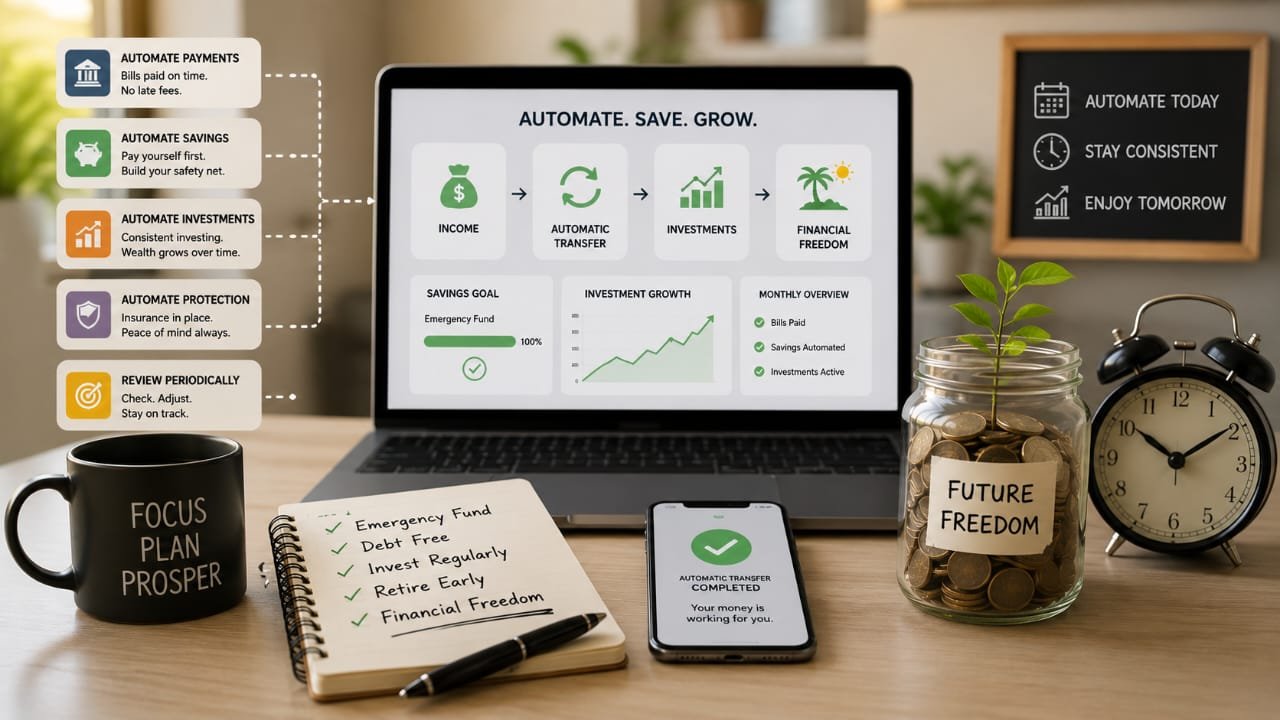
The secret to building long-term wealth isn’t obsessive micromanagement—it’s automation. By building a “set it and forget it” financial system, you remove human error, eliminate decision fatigue, and ensure your money works for you while you sleep.
Here is how to automate your personal finances in less than an hour with simple, high-impact tweaks.
The Automated Payday Routing System
The moment your paycheck hits your checking account, it should automatically dissolve into designated buckets. Instead of deciding how much to save each month, let your bank do the heavy lifting.
The “Pay Yourself First” Flow
- The 401(k) / Workplace Retirement Account: Set this up through your employer’s payroll system. It deducts money before it even reaches your main bank account. Aim to contribute at least enough to capture your full employer match—it’s free money.
- The High-Yield Savings Account (HYSA) Transfer: Set up an automatic recurring transfer for the day after payday. Move a fixed percentage (e.g., 10% to 20%) directly into your emergency fund or short-term savings goal bucket.
Pro-Tip: Don’t keep your savings at the same bank as your daily checking account. Out of sight, out of mind truly works to prevent impulse spending.
2. Automate Fixed Bills and Credit Cards
Manually tracking due dates is a recipe for missed payments, late fees, and dinged credit scores. By syncing your billing cycles with your income timeline, you can transform your monthly expenses into a background process that runs flawlessly without your manual intervention. How to safely automate your debt and bills:
- Utility & Subscription Tweaks: Link recurring fixed bills (internet, streaming services, insurance) to a cash-back or rewards credit card to rack up points automatically.
- The Statement Balance Guardrail: Set your credit card to automatically pay the Full Statement Balance every month from your primary checking account.
- The “Minimum” Safety Net: If you are dealing with irregular income and worry about overdrafts, at least set the automation to pay the Minimum Payment Due. This guarantees you never miss a due date or hurt your credit score, and you can manually pay off the rest when you check your accounts.
3. “Set It and Forget It” Investing
Market timing is a loser’s game. Instead, leverage Dollar-Cost Averaging (DCA) through automated investing.
By setting up recurring transfers to an individual brokerage account or Roth IRA, you buy more shares when prices are low and fewer shares when prices are high.
| Automation Step | Platform Example | Frequency | Target Asset |
| Retirement Auto-Invest | Vanguard, Fidelity, Charles Schwab | Monthly / Bi-weekly | Low-cost S&P 500 or Total Market Index Funds |
| Micro-Investing / Spare Change | Acorns, Robinhood | Daily / Per Transaction | Fractional shares or diversified ETFs |
If you want the ultimate “forget it” investment, look into Target-Date Funds (TDFs). You simply pick the fund closest to the year you plan to retire (e.g., Target Date 2060). The fund automatically rebalances its portfolio, shifting from aggressive stocks to conservative bonds as you get closer to retirement.
Minor Tweaks, Major RMieturns
Automation isn’t just about moving money; it’s about optimizing your accounts to work efficiently behind the scenes.
- Turn on Dividend Reinvestment (DRIP): Check the settings in your investment accounts and ensure DRIP is enabled. Instead of leaving stock payouts as idle cash, this feature automatically uses your dividends to buy more fractions of that stock, compounding your wealth faster.
- The Annual Escalator: Many workplace 401(k) platforms have an “auto-escalate” feature. Turn this on to automatically increase your contribution by just 1% each year. You’ll barely notice the difference in your paycheck, but it can add hundreds of thousands of dollars to your retirement nest egg over time.
- Set Up Balance Alerts: Avoid the stress of logging in daily by setting up text or email alerts for two specific triggers: Low Balance (e.g., when checking drops below $200) and Large Transaction (e.g., any charge over $100). This keeps you secure and aware without active tracking.
The 1-Hour Financial Freedom Checklist
To get started today, take 15 minutes to implement just one of these steps. Within a month, you can have a fully optimized, self-sustaining financial ecosystem.
- [ ] Log into your employer portal and maximize your retirement match.
- [ ] Schedule a recurring payday transfer to your High-Yield Savings Account.
- [ ] Set all utility and credit card bills to Auto-Pay.
- [ ] Enable DRIP (Dividend Reinvestment) on your brokerage accounts.