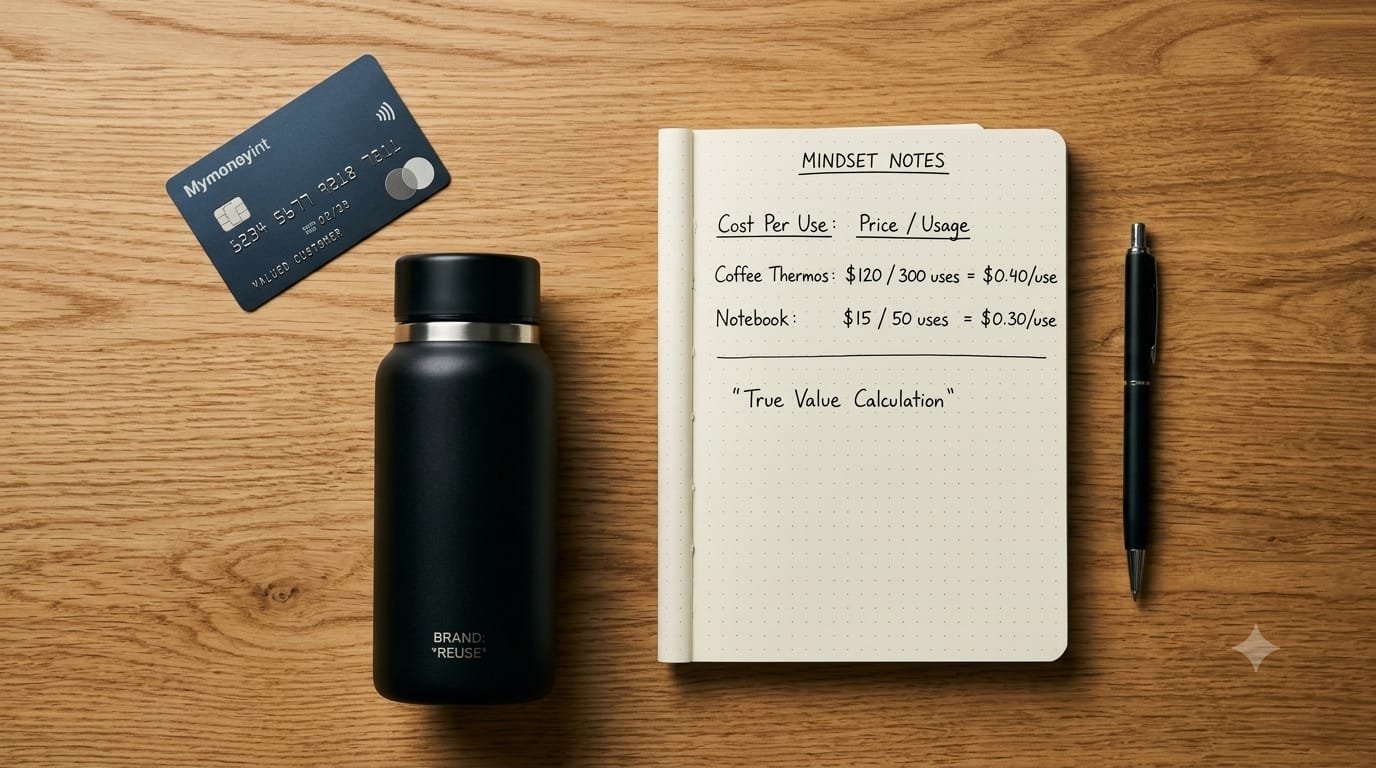
When you are trying to make smarter financial decisions, standard budgeting advice usually tells you to look at one thing: the price tag. Naturally, we are conditioned to think that spending less money upfront is always the “saver” move, whereas spending more is a “splurge.” However, this surface-level thinking hides a costly financial trap.
For instance, buying a cheap $20 pair of shoes that falls apart after three wears actually costs you significantly more over time than investing $120 in a durable pair that lasts for years. Consequently, adopting the cost per use mindset allows you to look past the upfront tag and calculate real, long-term value.
Ultimately, to break free from the cycle of buying cheap, disposable items that constantly need replacing, you must shift your financial perspective. By fully embracing the cost per use mindset, you gain a powerful framework that transforms how you view quality and daily spending habits. In fact, mastering the cost per use mindset is the single best mental model for making smarter, higher-quality purchases.
What is Cost Per Use (CPU)?
The Cost Per Use formula is incredibly simple, yet it completely flips the definition of “expensive” on its head:
Using this framework, a high upfront price tag can actually represent an incredibly cheap purchase over time. Conversely, a cheap item that you rarely use can turn out to be an exorbitant luxury.
The Math in Action: Cheap vs. Value
Let’s look at how the math plays out in the real world across two common everyday categories: wardrobe staples and kitchen appliances.
Case Study 1: The Winter Jacket
- Option A (The Fast-Fashion Route): You buy a trendy, cheap jacket for $40. The zipper breaks and the lining rips after one season. You wore it 10 times.
- Option B (The Investment Route): You spend $250 on a high-quality, classic, durable jacket with a lifetime warranty. You wear it 40 times a year over the course of 4 years (160 total uses).
Even though Option B required over 6 times more cash upfront, it is more than twice as cheap in reality.
Case Study 2: The Kitchen Gadget
The Fancy Blender: You buy a high-end blender for $400 because you commit to making daily breakfast smoothies. You use it 5 days a week for 2 years (520 uses).
The Countertop Juicer: You buy a cheaper juicer on sale for $80 on a whim. Cleaning it is a nightmare, so it sits in the back of your cabinet. You only used it 4 times before ignoring it.
The $80 “bargain” ended up being a massive waste of money, while the $400 “luxury” paid for itself daily.
The “Vimes Bibliothetic Theory” of Wealth
The concept of Cost Per Use aligns perfectly with a famous piece of economic satire from author Terry Pratchett, known as the Sam Vimes “Boots” Theory of Socioeconomic Unfairness:
”A really good pair of leather boots cost fifty dollars. But an affordable pair of boots, which were sort of OK for a season or two and then leaked like hell when the cardboard gave out, cost about ten dollars… But the thing was that good boots lasted for years and years. A man who could afford fifty dollars had a pair of boots that’d still be keeping his feet dry in ten years’ time, while the poor man who could only afford cheap boots would have spent a hundred dollars on boots in the same time and would still have wet feet.”
When you buy strictly based on the lowest price tag, you trap yourself in an expensive loop of forced upgrades. The Cost Per Use mindset is your ticket out of that cycle.
How to Apply the CPU Rule Daily
To implement this model into your daily life and start making optimized financial decisions, follow these three rules:
1. Identify Your “High-Frequency” Zones
Brainstorm the items in your life that you physically touch or use almost every single day. These are your high-frequency zones, where you should actively lean toward quality and durability, even if it costs more upfront:
- Your mattress and pillows (you spend a third of your life on them).
- Your work computer, phone, or primary productivity tools.
- Your everyday shoes and tires (anything that separates you from the ground).
- Your office chair.
2. Run the Mental Calculation Before Buying
The next time you are on the verge of buying a non-essential item, run a quick mental estimate of its projected lifespan and frequency of use.
If you are looking at a $150 dress for a wedding that you know you will realistically only wear once, its CPU is $150. Consider renting it instead. If you are buying a $100 backpack that you will carry to work every single day for the next three years (~750 uses), the CPU is roughly $0.13. Hit the checkout button with zero guilt.
3. Factor in Maintenance and Time Costs
Remember that the true cost of an item includes the time, effort, and money required to maintain it. A cheap car that requires $1,500 in annual repairs has a massively inflated Cost Per Use. A piece of clothing that requires dry-cleaning after every wear adds a hidden maintenance tax to your CPU.
The Bottom Line
True financial intelligence isn’t about being cheap; it’s about being efficient.
By shifting your mindset from “How much does this cost right now?” to “How much value will this yield over its lifetime?”, you protect your wallet from low-quality traps. Invest in what matters, skip what doesn’t, and let the math do the heavy lifting for your net worth.