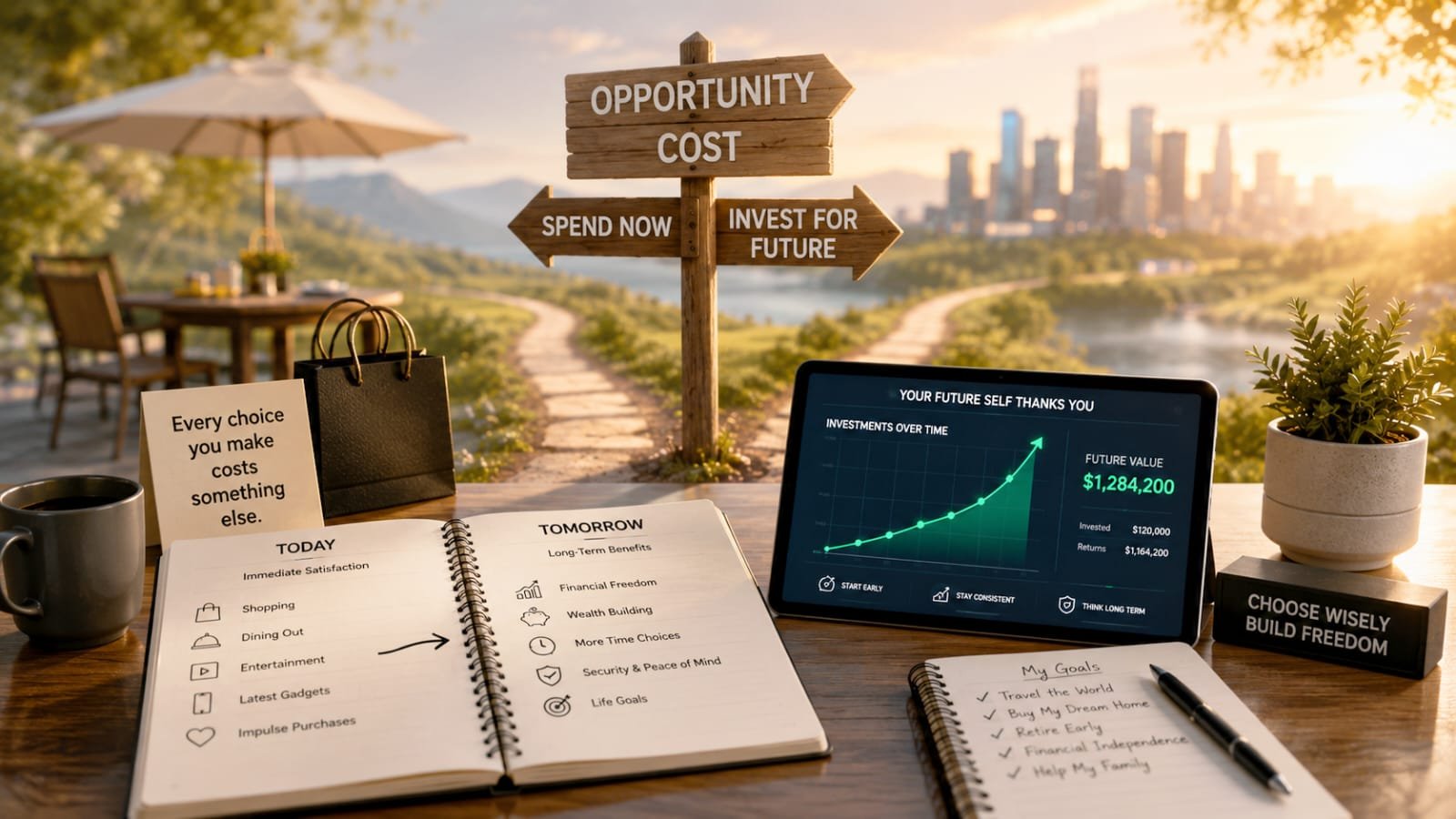
Every time you make a financial choice, you make an immediate sacrifice. When you hand over your card for a $60,000 new vehicle, you trade away much more than cash. You simultaneously choose not to invest that money, pay down your mortgage early, or fund an unforgettable international trip. In economics, people call this invisible trade-off opportunity cost. Simply put, opportunity cost measures the value of the next best alternative you abandon whenever you select a specific financial path. Traditional personal finance focuses on visible numbers like budgets, balances, and bills. However, elite financial planning demands strategic financial thinking. To build true generational wealth, you must calculate opportunity cost to see what a decision costs you in future freedom, growth, and security.
The Core Concept: Visualizing the Invisible
Most people evaluate purchases based entirely on price tags today. If a subscription costs $50 a month, they check their bank account, see $50 available, and complete the purchase. Therefore, they believe the decision costs exactly $50. Conversely, a strategic thinker views this transaction through a wider economic lens. They recognize that you can spend money only once. Once that cash leaves your ecosystem, its potential to generate more wealth disappears forever. Furthermore, calculating opportunity cost allows you to measure these dynamic shifts clearly through a basic formula:
For instance, consider leaving $10,000 in a traditional checking account earning almost zero interest. If you leave it there instead of using a high-yield savings account or a market index fund earning 7%, your opportunity cost reaches roughly $700 every year in lost growth. Thus, you actively pay a heavy tax for inaction. By factoring in opportunity cost, you avoid leaving easy wealth on the table. Understanding opportunity cost transforms passive savers into active investors who maximize every single dollar.
3 Strategic Frameworks to Optimize Opportunity Cost
To embed this economic concept into your daily life without experiencing mental fatigue, you can use three practical frameworks to evaluate your options. By using these frameworks, you ensure that opportunity cost works for you rather than against your future. Evaluating opportunity cost routinely helps you make intentional decisions with confidence. Furthermore, keeping opportunity cost top of mind protects your wealth from slipping away through unexamined daily habits.
1. The Future Value Multiplier (The “Real” Cost of Spending)
The next time you want a major non-essential luxury purchase, do not look at the immediate price tag alone. Instead, multiply the price tag by what that money could become if you invested it in a broad-market fund for 20 years. At a standard 7% annual return, your money doubles roughly every 10 years. Therefore, a $1,000 luxury purchase today actually carries an opportunity cost of $4,000 from your future retirement nest egg. This massive opportunity cost shows how small purchases today compound into substantial losses tomorrow.
Strategic Shift: Ask yourself: “Is this item worth $1,000 to me today, or would I rather have $4,000 in my portfolio later?” Sometimes the answer is yes, and that is perfectly fine. The goal is not to stop spending entirely; the goal is to make the trade-off highly intentional.
2. Debt Paydown vs. Market Investing
One of the most fiercely debated topics in personal finance is whether to aggressively pay off debt or route extra cash into the stock market. Strategic financial thinking simplifies this dilemma by comparing the mathematical opportunity costs.
- Paying down debt gives you a guaranteed return equal to the interest rate of the loan. If you pay off a credit card with a 20% interest rate, you are effectively locking in a guaranteed 20% return on your money.
- Investing in the market historically yields an average annual return of 7% to 10% over the long term.
If you have a low-interest mortgage locked in at 3.5%, the opportunity cost of aggressively pouring all your spare cash into paying down that mortgage early is incredibly high. By doing so, you are giving up the potential 7% to 10% returns you could have captured by investing that cash in the market instead. Conversely, holding onto 20% credit card debt while trying to invest in the stock market is a losing mathematical equation.
3. Time Capitalization: Cash vs. Labor
Opportunity cost doesn’t just apply to currency; it applies heavily to your time. Your time is a finite resource that possesses a specific financial value. Imagine you want to paint your house. A professional contractor quotes you $3,000 for the job. You decide to do it yourself to “save money,” spending three full weekends buying supplies, taping walls, and painting.
If your personal hourly earning capacity or the value you place on rare free time exceeds the implied hourly savings of doing the work yourself, your DIY project creates a net negative result. You sacrifice precious hours of high-value energy, creating an unfavorable opportunity cost. Weighing opportunity cost in terms of time prevents you from sacrificing high-value hours for low-value savings. Ultimately, analyzing opportunity cost ensures you spend your time where it delivers the highest return.
Balancing the Equation: Financial vs. Human Utility
While mathematics provides a clean, logical foundation, human beings are not cold calculators. A common pitfall of over-analyzing opportunity cost is falling into a state of chronic guilt, where you feel anxious spending any money because it carries an opportunity cost. Strategic financial thinking requires you to balance mathematical optimization with personal fulfillment, safety, and health. Understanding opportunity cost helps you evaluate trade-offs rationally without robbing yourself of joy
| Financial Move | Pure Mathematical Cost | The Human Utility Benefit | The Strategic Verdict |
| Keeping an Emergency Fund in Cash | Loses purchasing power to annual inflation | Provides mental peace and prevents high-interest debt during a crisis | Excellent Move. The psychological protection outweighs the lost market returns. |
| Buying a Gym Membership | Costs money that could be compounding in an ETF | Improves physical health, lowers future medical bills, and boosts cognitive output | Excellent Move. Investing in your health assets yields the highest lifetime returns |
| Financing a Depreciating Luxury Asset | Heavy upfront cost, rapid depreciation, and lost investment potential | Temporary social status or brief dopamine hit | Poor Move.* The high opportunity cost outweighs the short-term utility |
Designing a Self-Correcting Ecosystem
The ultimate goal of mastering opportunity cost is to build a system where your baseline choices are automatically optimized.
Start by auditing your largest capital allocations. Look at your idle cash sitting in low-yield checking accounts, review your current loan interest rates, and analyze your recurring monthly expenditures. By making subtle structural shifts such as automating your investments and assigning a future-value multiplier to your spending, you ensure that the opportunity cost of your daily life works in your favor.
Remember, you are always paying for your choices. By mastering strategic financial thinking, you ensure that what you choose to keep is always worth more than what you choose to leave behind.